Egeria 23/2025
Rivista semestrale dell’Istituto Superiore di Scienze Religiose della Toscana (ISSRT) «Santa Caterina da Siena»
Vai alla pagina principale della Rivista
Contributi di Eric Noffke, Agnese Maria Fortuna, Marcello Marino, Gérard Rossé, Nadia Toschi Vespasiani
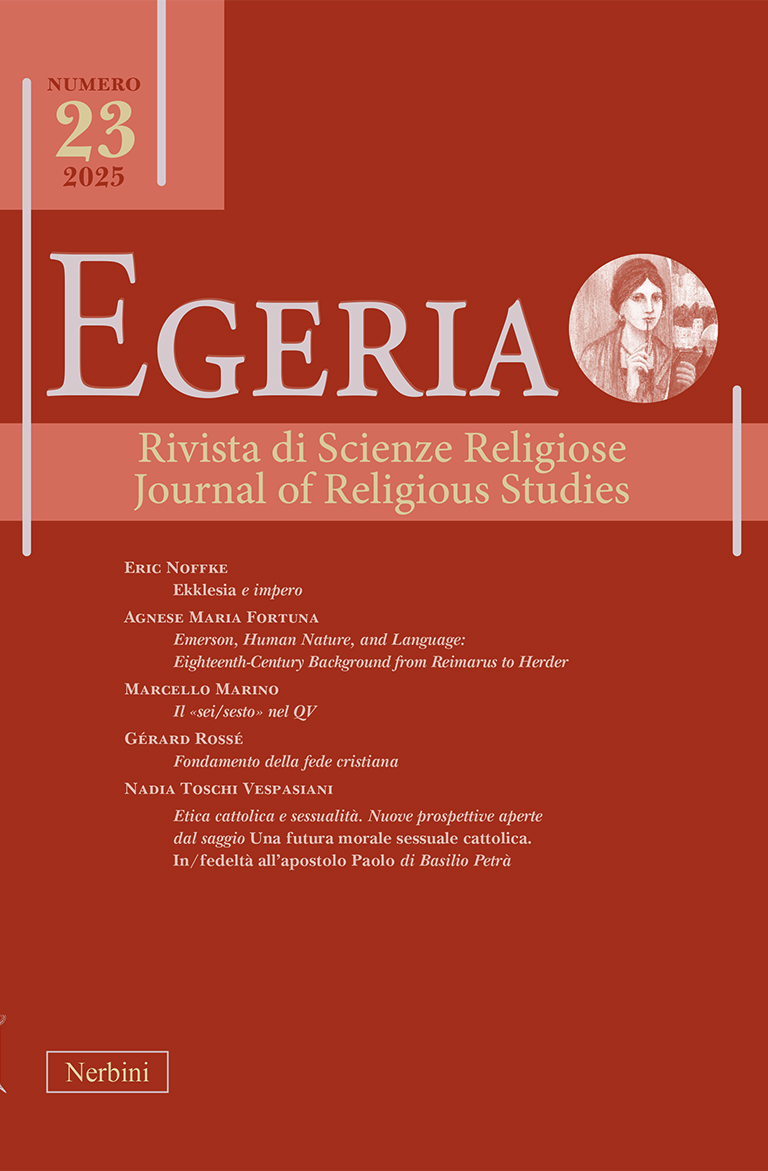
Egeria 23/2025
Agnese Maria Fortuna
Emerson, Human Nature, and Language: Eighteenth-Century Background from Reimarus to Herder
Abstract
L’interesse di Emerson per la natura, alimentato dal suo entusiasmo per le scoperte e le teorie scientifiche, fu plasmato e sostenuto dalla sua appassionata adesione alla visione simbolica della natura sostenuta dal movimento romantico tedesco e inglese. Tuttavia, temi, concetti e articolazioni che ricorrono nel pensiero di Emerson, soprattutto nel periodo di transizione che precede la pubblicazione di Nature (1836), sono già rintracciabili nei dibattiti sulla specificità umana del XVIII secolo, in particolare nelle opere di Reimarus e Herder. Emerson concepisce la natura come espressione dello Spirito creatore. Cogliere il suo ordine e il suo significato è ciò che distingue l’essere umano come creatura dotata di riflessione e linguaggio. Data la corrispondenza tra leggi di natura e leggi morali, la creazione del mondo di significati condivisi, che è il mondo propriamente umano, comporta un impegno costante per il miglioramento individuale e sociale inteso come fedele attualizzazione della verità iscritta dallo Spirito nella natura.
Emerson’s early interest in nature, nourished by his enthusiasm for scientific discoveries and theories, was shaped and supported by his passionate adhesion to the symbolic view of nature endorsed by the German and English Romantic movement. Nevertheless, themes, concepts, and articulations that recur in Emerson’s thinking, especially the transitional period before the publication of Nature (1836), can be found in the debates on human specificity of the eighteenth-century, in particular in the works of Reimarus and Herder. Emerson conceived nature as an expression of the creative Spirit. Grasping its order and meaningfulness is what distinguishes the human being as a creature endowed with reflection and language. Given the correspondence between laws of nature and moral laws, the creation of the world of shared meanings, which is the properly human world, entails a constant commitment to individual and social improvement understood as a faithful actualization of the truth inscribed by the Spirit in nature.
A.M. Fortuna, Emerson, Human Nature, and Language: Eighteenth-Century Background from Reimarus to Herder, in Egeria 14/23 (2025), 35-62