The Reception of St. Gregory of Nyssa in the Christian Traditions
Proceedings of the Third Patristic Symposium Organized by the Center for Patristic Studies and Ancient Christian Literature (“Babeș-Bolyai” University, Cluj-Napoca, 29 September – 1 October 2022).
Edited by Szabolcs András, Adrian Podaru, Hajnalka Tamas, George Claudiu Tuțu
Contributi di Szabolcs András, Adrian Podaru, Hajnalka Tamas, George Claudiu Tuțu, Claudio Moreschini, Giulio Maspero, Cecilia Flueraș, Lucian Dîncă, Guido Innocenzo Gargano, László Perendy, Marius Portaru, Eugen Maftei
Compra su Nerbini.it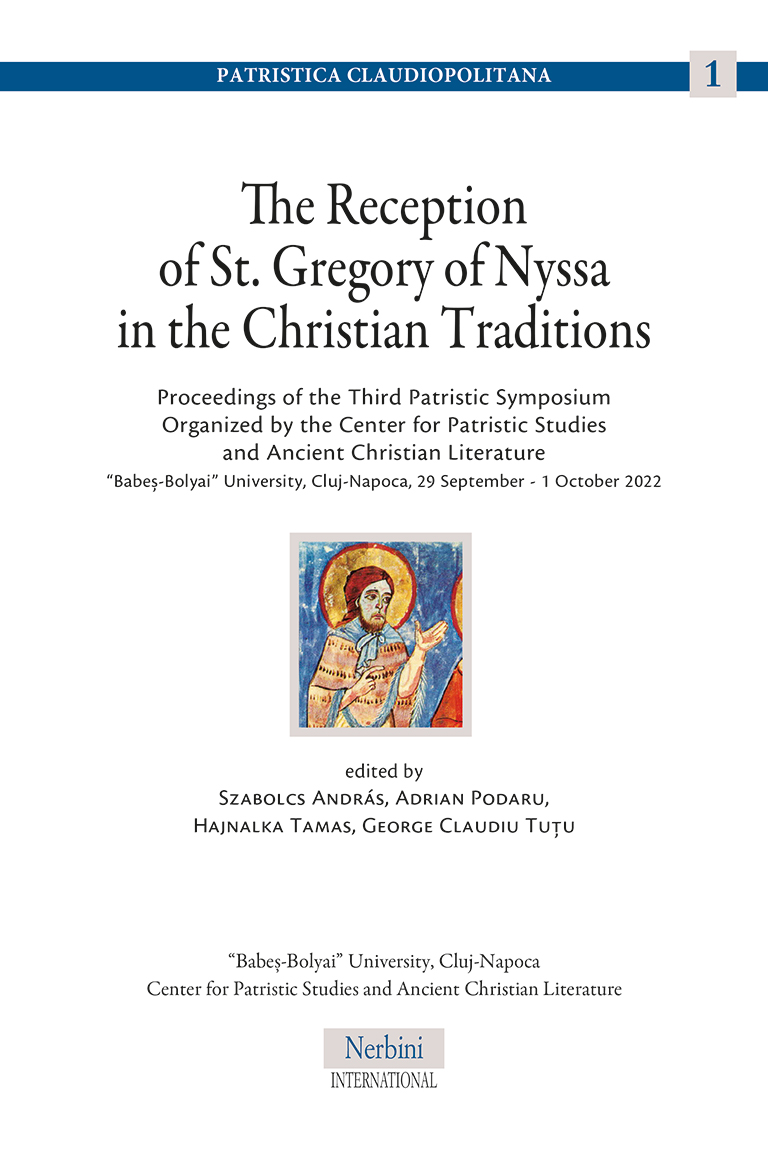
The Reception of St. Gregory of Nyssa in the Christian Traditions
László Perendy
The Influence of the Anti-Apollinarian Works of Gregory of Nyssa on the Tractatus in Evangelium Iohannis of Saint Augustine
Abstract
In Io. eu. tr. 47,9 Augustine defines the teaching of the disciples of Apollinaris of Laodicea in the following way: “Apollinaristae haeretici dicti sunt, qui ausi sunt dogmatizare quod Christus non sit nisi Verbum et caro: animam humanam non eum assumpsisse contendunt”. It is unlikely that the bishop of Hippo had at his disposal any sources in Latin about this Christological heresy, which was not so widespread and threatening in the West as in the East. Nevertheless, he was concerned and seemingly well informed about it already at the end of fourth century, not to say the 410s, when he was writing his commentary on the Gospel of John. What could have been his sources? The main elements of Augustine’s Christological utterances in this tractatus (“totus autem homo in Christo; Non enim partem deteriorem suscepisset, et partem meliorem deseruisset”, etc.) can be found also in the Antirrheticus of Gregory of Nyssa (GNO 3/1, 133, 140, 141, 165). Some statements of the Io. eu. tr. 52,3 about the incarnation of the Verb (i.e., “Deus incommutabilis mansit, et hominem in melius commutavit”) may also have come from the Antirrheticus (GNO 3/1, 223). In Io. eu. tr. 47,10 Augustine accentuates that Christ’s soul was not separated from the Word even when Christ died on the cross: “Animam vero a Verbo non separavit”. In this case Augustine’s arguments could have been drawn from another work of Gregory’s, titled De tridui spatio (GNO 9/1, 290–293, 304). But this problem is treated by Gregory also in his Antirrheticus (GNO 3/1, 152–153; 224–225). Based on the results of the research done by László Vanyó, in my contribution I treat of these and other parallelisms in detail, which point to the direction that Augustine followed closely the efforts of the Eastern bishops fighting Apollinarianism (especially those of Gregory of Nyssa) and he utilized their results extensively especially in his Tractatus in Evangelium Iohannis.
L. Perendy SchP, The Influence of the Anti-Apollinarian Works of Gregory of Nyssa on the Tractatus in Evangelium Iohannis of Saint Augustine, in S. András – A. Podaru – H. Tamas – G.C. Tuțu (a cura di), The Reception of St. Gregory of Nyssa in the Christian Traditions. Proceedings of the Third Patristic Symposium Organized by the Center for Patristic Studies and Ancient Christian Literature (“Babeș-Bolyai” University, Cluj-Napoca, 29 September – 1 October 2022), Nerbini International, Firenze 2026, 129-141