The Reception of St. Gregory of Nyssa in the Christian Traditions
Proceedings of the Third Patristic Symposium Organized by the Center for Patristic Studies and Ancient Christian Literature (“Babeș-Bolyai” University, Cluj-Napoca, 29 September – 1 October 2022).
Edited by Szabolcs András, Adrian Podaru, Hajnalka Tamas, George Claudiu Tuțu
Contributi di Szabolcs András, Adrian Podaru, Hajnalka Tamas, George Claudiu Tuțu, Claudio Moreschini, Giulio Maspero, Cecilia Flueraș, Lucian Dîncă, Guido Innocenzo Gargano, László Perendy, Marius Portaru, Eugen Maftei
Compra su Nerbini.it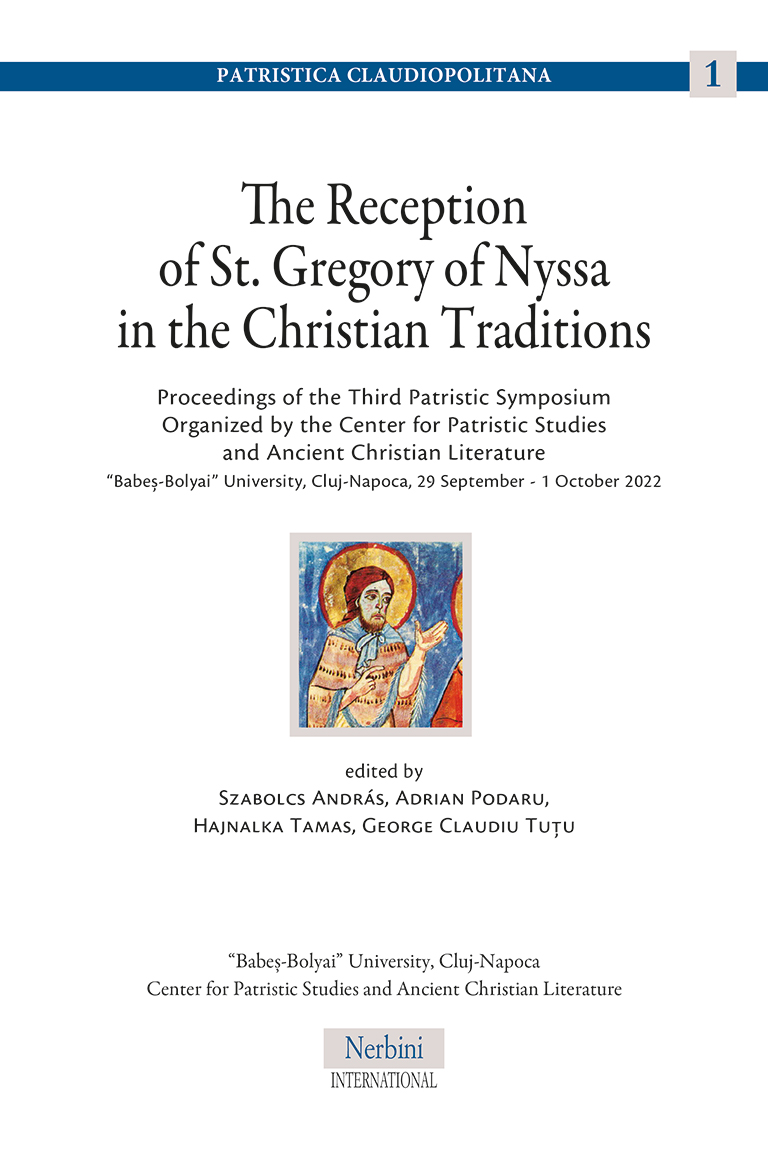
The Reception of St. Gregory of Nyssa in the Christian Traditions
Cecilia Flueraș
Le omelie liturgiche di Gregorio di Nissa. Un contributo allo sviluppo dell’anno liturgico
Abstract
In the fourth century in which the Cappadocian Father Gregory of Nyssa lived, the Church was confronted with the Trinitarian and Christological heresies. The Church Fathers established in the first ecumenical councils (Nicaea, Constantinople) the main dogmas of faith. These are reflected in their preaching but also in the liturgy, which becomes a means of theological controversy. Thus, Christmas becomes the feast of the Incarnate Word and Pentecost, the feast of the dogma of the Holy Spirit. Gregory, bishop of Nyssa, was one of the great defenders of the orthodoxy of the Christian faith. His liturgical homilies are the fruit of his liturgical and catechetical efforts, especially for the Christians of his bishopric. The homilies attest to the existence of the liturgical year with the Easter and Christmas cycles and reveal in particular, for Gregory, a situation of “transition” from unitary celebration to the historicization of the mystery of Christ. Beyond the biblical and doctrinal content of liturgical feasts, beyond the testimony regarding the conduct of worship and the succession of rites, Gregory dwells on the mystical and spiritual aspect of liturgical worship, calling it a “mystery”. To introduce the faithful to the mystery of worship, the Nyssen makes use of certain constituent elements of worship: the logoi (words, actions, events of the Old Testament and New Testament, psalms – phonai), the sacred actions (the liturgical rites) and finally, the symbolism of psalmody, namely the singing of psalms performed by the whole community. Gregory of Nyssa’s legacy can be identified above all in the mystical nature of Byzantine hymnography, revealing itself as a growth in participation and understanding of the mystery of salvation contained in liturgical feasts, as well as in the awareness that the mystery of worship invites the community of believers to experience with joy and exultation the reconstitution of the unity of redeemed human nature with angelic nature, of the harmony of all creation.
C. Flueraș, Le omelie liturgiche di Gregorio di Nissa. Un contributo allo sviluppo dell’anno liturgico, in S. András – A. Podaru – H. Tamas – G.C. Tuțu (a cura di), The Reception of St. Gregory of Nyssa in the Christian Traditions. Proceedings of the Third Patristic Symposium Organized by the Center for Patristic Studies and Ancient Christian Literature (“Babeș-Bolyai” University, Cluj-Napoca, 29 September – 1 October 2022), Nerbini International, Firenze 2026, 63-79